
How to Illustrate a Children's Book Consistently
Plan illustrations for a children’s book, maintain character continuity and coordinate page artwork, text and the final cover.
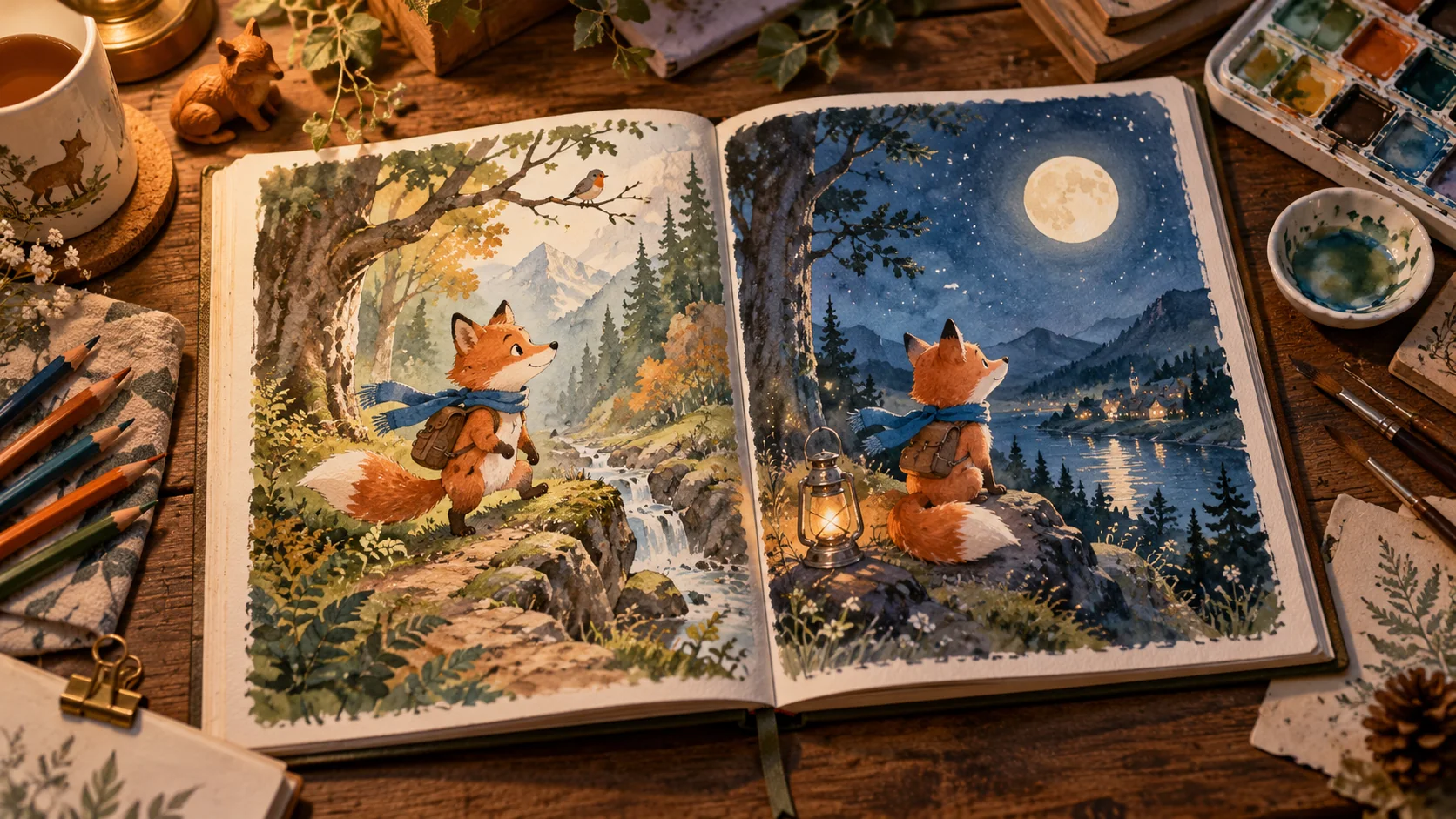
To illustrate a children's book consistently, plan the story, character rules and page sequence before producing finished art. The illustrations need to carry action and emotion across several scenes, not simply look attractive one page at a time.
Start with the actual edition
Confirm the manuscript, intended reader, page or spread count, trim and publisher requirements. Do not assume every picture book uses one fixed length. Make a small dummy with the actual text placement and page turns before finishing the images.
For an original practice story, use a young fox named Otis who plants a seed, waits impatiently and discovers that small daily care changes the result. This is a teaching concept, not a published book or a client example.
Define the character in observable terms
| Feature | Otis reference rule |
|---|---|
| Body | Small rounded torso with a broad tail |
| Head | Soft triangular shape and short muzzle |
| Clothing | One plain blue scarf |
| Palette | Warm rust, cream and a dark brown anchor |
| Expression | Simple brow, eye and mouth changes |
| Scale | Consistent relation to the pot and garden tools |
Make front, side and three-quarter studies. Add a few expressions and poses. Keep the stable features separate from the features that change with action. A reference sheet should help you identify drift, not freeze every expression.
Build the sequence as thumbnails
| Spread in the exercise | Visible action | Illustration decision |
|---|---|---|
| 1 | Otis finds the seed | A close object detail and a curious pose |
| 2 | Otis prepares the pot | A wider view that explains the tools |
| 3 | Otis waits | Repeated pose with a small time change |
| 4 | Otis waters the soil | Clear hand and pot relationship |
| 5 | A shoot appears | A quiet focal detail |
| 6 | Otis shares the plant | A wider closing relationship |
The six-spread structure is only this exercise's plan. Adapt the sequence to the actual manuscript and edition.
Use page turns deliberately
Decide what the reader knows before a turn and what is revealed after it. The appearance of the shoot can earn a turn because it changes the situation. A page turn should not hide an essential part of the same unclear action merely to create a surprise.
Leave text space during composition. Keep key faces and actions away from binding or trim areas according to the publisher's template. A beautiful scene that has no place for the words needs revision before finishing.
Produce a controlled art pass
Finish one representative spread first. Establish shape language, line or edge treatment, palette and light. Use that approved reference beside the next spread, while allowing the scene to have its own framing and action.
If using AI concepts, provide the authorized character reference and describe the specific pose. Compare the head, scarf, tail and proportions in every result. Do not assume one character name or seed setting guarantees consistency across tools or versions.
Keep the exact manuscript text outside generated art until it is set in a controlled layout. Check spelling, line breaks and reading order independently from the illustration.
Review the book as a whole
Place all spreads in order. Check character identity, object scale, action continuity and the rhythm between close and wider views. Read aloud while turning pages. Note where the picture repeats the text without adding useful information and where it leaves an important action unclear.
For print, use the edition-specific template and proof process. KDP's cover calculator is one official example for cover dimensions; interior requirements and other publishers need their own guidance.
Use Cuta's image workspace for character and scene exploration, then keep the finished sequence, exact text and production layout under deliberate review. Label concepts and actual finished spreads accurately.
Track a character across facing pages
For an original story about a child carrying a yellow watering can, define the can shape, handle side, clothing and relative height before making page scenes. A continuity sheet is more useful than a broad prompt asking for the same style. Separate fixed identity features from changes required by the action, such as a lifted arm or a different viewing angle.
Make a quiet page and a busy page early. They reveal whether the character remains recognizable under different lighting and composition. Put important gestures outside the gutter and reserve the actual text area. Finish exact lettering separately; do not rely on a generated illustration to reproduce the manuscript accurately.
| Spread | Identity detail to preserve | Observation |
|---|---|---|
| Garden introduction | Clothing and watering-can silhouette | Record accepted reference |
| Carrying action | Handle, hand and relative scale | Note continuity corrections |
| Evening ending | Same character under changed light | Mark gutter and text clearance |
Download the picture-book continuity ledger as an editable CSV. Fill the observation column with your own project notes.